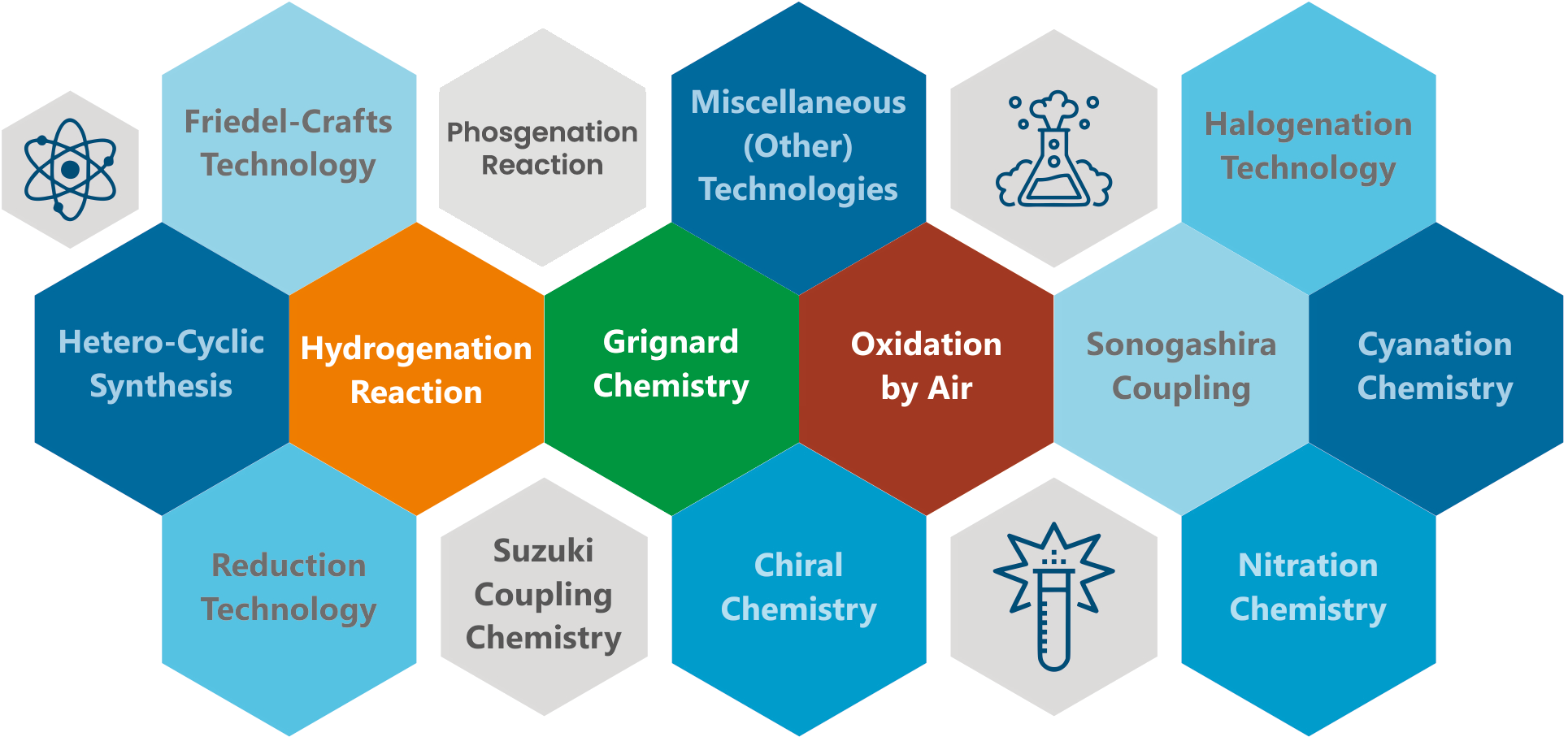
Hydrogenation is a chemical reaction between molecular hydrogen (H2) and another compound or element, usually in the presence of a catalyst such as nickel, palladium or platinum. The process is commonly employed to reduce or saturate organic compounds.
Expertise in reaction of organometallic chemical reactions where alkyl, allyl, vinyl or aryl magnesium halides are reacted with electrophilic carbonyl compounds.
Oxidation chemical reaction technology for pharmaceutical intermediate synthesis using Hydrogen Peroxide, Nitric Acid and Sodium Hypochlorite.
Expertise in chemical reactions which involves alkulation or acylation of aromatic ring with an alkyl halide or acid chloride using strong Lewis's acid.
We expertise in synthesis where ring formation or modification is done using precursors. By this, cyclic compounds of carbon or non-carbon elements are created.
RT expertise in synthetic routes using reduction chemical reaction like Hydrogenation, Wolff-Kishner and reduction using Borohydric salts.
This is a widely used cross coupling reaction between an organohalide & an organoborinic acid. The reaction is typically catalysed by a Pd- based catalyst & runs under mild conditions.
The expertise of high selective of the desired isomer has been gained with years of experience of synthesis of the chiral molecules for speciality chemicals.
Numerous further chemical reactions complete our capacities for multi-stage synthesis. These reaction types are routinely performed in addition to the main reactions.
The Sonogashira reaction is a cross-coupling reaction used in organic synthesis to form carbon-carbon bonds employing a palladium catalyst as well as copper co-catalyst.
Nitration is used to add nitrogen to a benzene ring, which can be used further in substitution reactions. The nitro group acts as a ring deactivator.
In organic synthesis, cyanation is the attachment or substitution of a cyanide group on various substrates. Such transformations are high-value because they generate C-C bonds.
At RT, we undertake two types of halogenations reactions: substitution and addition reactions. Know more about Chlorination and Bromination expertise.
Production. Industrially, phosgene is produced by passing triphosgene or purified carbon monoxide and chlorine gas through a bed of porous activated carbon.
